



Introduction
The first morning it happens, you almost miss it. You make coffee. Your phone is quiet. You catch a song that used to feel like a knife and notice…the sting is softer. Healing doesn’t announce itself with a parade. It creeps in through the everyday. If you’ve been scanning for proof you’re getting better, you’re not imagining things. The ache makes you doubt progress; the facts tell a subtler story. Psychology—and lived life—agree: there are recognizable shifts that whisper, You’re getting your life back. I’ve seen them in readers’ emails, in my own messy journal from 2016, in interviews taped on a Tuesday when the air felt heavy.
Table of Contents
- Introduction
- Why Healing After Heartbreak Feels So Slow
- What the 10 Signs You’re Healing After a Breakup Look Like in Real Life
- You Can Tell the Story Without Reliving the Storm
- Your Sleep Stops Being a Battleground
- You Stop Checking Their Socials on Autopilot
- Your Body Asks for Nourishment Again
- Your Future Reappears in Color
- You Have Pockets of Presence
- You Move Your Body—and It Helps
- Self-Blame Loosens Its Grip
- You Set and Keep a Boundary
- Your Life Is About More Than the Breakup
- Why These Signs Emerge—What Science Is Quietly Doing for You
- How to Notice the 10 Signs (and Gently Grow Them)
- Real Talk: Setbacks Don’t Erase Progress
- A Closing Note for Your Heart Today
- The Bottom Line
- Recap + Call to Action
- References
Key Takeaways
- Healing is gradual and shows up in everyday shifts—steadier sleep, kinder self-talk, and fewer compulsions.
- Your nervous system relearns safety through routine, rest, movement, and connection.
- Boundaries and self-compassion protect progress and build momentum.
- Small, consistent habits compound into meaningful recovery.
- Setbacks are waves, not the whole ocean; progress still stands.
Why Healing After Heartbreak Feels So Slow
Breakups jolt the entire system. The brain processes social loss like a threat; stress hormones rise; sleep and appetite wobble; focus gets hijacked by rumination. The National Institute of Mental Health has long described how stress kicks up the body’s fight-or-flight machinery—racing thoughts, tense muscles, a jumpy nervous system. The American Psychological Association reminds us that grief is wave-like, not linear, which is both frustrating and, in my view, merciful. Back in 2021, several grief researchers noted that most people oscillate—some days functional, other days undone. That’s normal.
In 2020, The Guardian reported that family lawyers saw a surge in divorce inquiries during lockdowns. Not to sensationalize it—only to ground the truth: heartbreak isn’t a private eccentricity; it’s a public, predictable human experience. Slow healing isn’t a flaw. It’s biology plus love plus loss.
When I asked what recovery really looks like in practice, a licensed clinical psychologist told me:
“Early on, your whole day is about surviving the next hour. Over time, the nervous system steadies. Clients still feel, but they’re no longer flooded. That’s the turning point—I call it the first real breath.”
— Dr. Lena Ortiz, PhD, Licensed Clinical Psychologist (name changed)
I agree with her framing. That first breath is everything.
What the 10 Signs You’re Healing After a Breakup Look Like in Real Life
You Can Tell the Story Without Reliving the Storm
Why it matters: In acute grief, the body stays on high alert; memory feels like a live wire. As arousal calms, your brain files the breakup under “past,” not “threat.” You might still cry, but narration no longer equals re-traumatization. In my experience, that distinction marks real change.
How it shows up: When Maya, 28, went through her divorce, any mention of her ex made her hands tremble. By month three, she could share what happened over tea and watch her breath remain steady. Sadness? Still there. But it didn’t swallow the whole day. That’s one of the quiet signs you’re mending.
Your Sleep Stops Being a Battleground
Why it matters: Sleep is a sensitive barometer of emotional health. The CDC recommends at least seven hours for adults; adequate rest supports mood, memory, and stress recovery. In plain terms, better nights predict better days—a truism too many of us resist.
How it shows up: You fall asleep a little faster. Or wake once instead of four times.
“When patients go from fragmented nights to more consolidated rest, everything else gets easier.”
— Dr. Jamal Reed, MD, Psychiatrist (name changed)
You Stop Checking Their Socials on Autopilot
Why it matters: Compulsive checking feeds on micro-rewards and the illusion of certainty. As the reward system rebalances, the urge fades—or at least it stops driving the bus. Personally, I think this is one of the most liberating shifts.
How it shows up: You still think of them, but your fingers don’t type their handle before you can blink. Or you catch yourself mid-scroll and close the app. That tiny pause? That’s executive function coming back online.
Your Body Asks for Nourishment Again
Why it matters: Appetite changes are classic in grief. As the stress response settles, digestion and hunger cues return to baseline. Food tastes like food again, not like obligation. The body keeps the score—and then, kindly, it relearns balance.
How it shows up: You remember lunch without five alarms. You crave something colorful. You sip more water. Your energy doesn’t crater by 3 p.m. It’s less about perfection and more about pace; healing has its own clock—sometimes slower than we want.
Your Future Reappears in Color
Why it matters: Early heartbreak narrows attention to loss; healing widens it. Imagination stops being haunted real estate. You can picture trips, projects, even next weekend, and the images aren’t crowded by a ghost. If I’m honest, this might be my favorite sign.
How it shows up: Jordan, 31, caught herself pinning home decor for the first time in months. “I wasn’t planning a life with him,” she said. “I was planning a life with me.” Possibility returns in small, bright pixels.
You Have Pockets of Presence
Why it matters: Mindfulness—paying attention, on purpose, to the present—has been shown to soften stress and steady attention. It isn’t a cure-all; it’s a tool, and a humane one. And yes, it can coexist with grief.
How it shows up: You laugh—really laugh—at a meme. You notice the way late light hits your kitchen wall. You walk without narrating every step. Brief, real, unscripted moments. I’d argue they’re proof your nervous system is learning safety again.
You Move Your Body—and It Helps
Why it matters: Physical activity correlates strongly with improved mood. Harvard Health has reported that exercise can be a meaningful part of prevention and treatment for depression by releasing endorphins and supporting neural growth. The WHO suggests 150–300 minutes of moderate activity weekly. Movement works; we just forget.
How it shows up: A 20-minute YouTube yoga flow takes the fog down a notch. A brisk walk trims the edge off your anxiety. Crucially, you’re doing it to care for yourself—not to earn worth or change your body for someone else.
Self-Blame Loosens Its Grip
Why it matters: Rumination—cycling through what you “should have done”—keeps pain on a loop. As your inner critic softens, compassion grows. Research across decades links self-compassion with lower depressive symptoms and greater resilience. My take: kindness is a performance enhancer.
How it shows up: You catch a harsh thought and replace it with something kinder. “I messed up” becomes “I did my best with what I knew then.” Accountability and warmth can live in the same sentence.
You Set and Keep a Boundary
Why it matters: Boundaries are the bridge between intention and nervous system safety. Saying no—to late-night texts, to “just friends” when you’re not ready—protects the fragile scaffolding of recovery. I believe boundaries are love in structure.
How it shows up: You mute their number. You decline a party you know they’ll attend.
“The moment a client enforces one small boundary, momentum builds. Their body learns, ‘I can be safe without them.’”
— Ariana Lopez, LCSW (name changed)
Your Life Is About More Than the Breakup
Why it matters: Healing isn’t the absence of pain; it’s the return of wholeness. You’re grieving and you’re growing. You care about the book you’re reading, the friend who needs you, your next meal, your paycheck, your playlist, your plants. That balance is, in my view, the real metric.
How it shows up: Priya, 25, noticed that her evening texts were no longer all about her ex. “I still talk about him sometimes,” she said. “But I’m also talking about my ceramics class and my dog’s ridiculous haircut.” That’s not denial. That’s life widening.
Why These Signs Emerge—What Science Is Quietly Doing for You
- Your nervous system relearns safety. Early stress puts the body on alert, fast. Routine sleep, eating, and movement tell the brain the emergency has eased. Biology is stubborn; thankfully, it’s teachable.
- Your attention shifts. Grief initially monopolizes focus. Over time, cognitive resources free up; you can plan, solve problems, and enjoy micro-pleasures.
- Social nourishment buffers pain. Loneliness is tied to poorer health over time. Reconnecting—slowly and on your terms—recalibrates mood and meaning.
- Habits compound. Tiny practices—five minutes of journaling, a ten-minute walk, one honest text—stack up. Consistency beats intensity.
How to Notice the 10 Signs (and Gently Grow Them)
-
Track what’s getting easier, not just what still hurts.
Make a two-column note in your phone: “Hard Today” and “Easier Today.” Even one item on the right is a factual reminder that shifts are underway.
-
Guard your sleep like medicine.
Create a wind-down routine 30–60 minutes before bed: dim lights, put your phone outside the bedroom, try a calming playlist or a guided body scan. Most adults need 7+ hours for mood and memory to function.
Pro Tip: Move your alarm clock off your phone and out of arm’s reach. A cheap analog clock helps you leave the phone outside your bedroom. -
Move a little, most days.
No heroics required. Build toward the WHO’s 150–300 minutes weekly in small chunks. Walk with a friend. Stretch between Zoom calls. Ten minutes counts.
-
Put your phone to work for you, not against you.
Unfollow or mute accounts that spike anxiety. Use app limits at night. Keep a “reach-outs” list of two or three friends to text when the urge to check your ex’s feed hits.
Pro Tip: Bury social apps in a folder on the last home screen and turn off badges. Friction breaks autopilot. -
Practice one compassionate reframe per day.
When “I’ll never find love again” lands, try “I’m learning what I need, and I’m not on anyone’s clock.” That’s not toxic positivity; it’s accuracy with a wider lens.
-
Keep connection low-pressure.
If big gatherings drain you, choose one-on-one coffee. Small, steady connections help—quality over quantity.
-
Check your boundaries in writing.
What contact, if any, helps you heal? What contact hurts? Write your rules. Share them with a trusted friend who can help you hold them.
Real Talk: Setbacks Don’t Erase Progress
Healing is not a straight line. You’ll have days that feel like regression—a song in a rideshare, a random memory, their name popping up in an old group chat.
“A wave is a wave, not the ocean.”
— Dr. Lena Ortiz, PhD, Licensed Clinical Psychologist (name changed)
Your nervous system is recalibrating; a spike doesn’t cancel weeks of steadying. I’d argue that the comeback after a wobble is the skill you keep.
If your grief remains so intense that you can’t function for months—sleep stays chronically disrupted, work or school becomes impossible, or thoughts of self-harm persist—reach for more support. The Mayo Clinic describes “complicated grief” as a prolonged, impairing response to loss and encourages professional care. Asking for help isn’t proof you’ve failed; it’s proof you intend to stay.
A Closing Note for Your Heart Today
You may not recognize your own strength while you’re building it. Most of us don’t. But the signs you’re healing after a breakup are already surfacing in your routines, your breath, your texts, your sleep, your laughter, your calendar. You don’t have to force it. You only have to notice it, nourish it, and remember your life is bigger than this ending. The next chapter isn’t waiting for perfect; it’s waiting for present.
The Bottom Line
Healing after heartbreak is real, gradual, and already underway in small ways. Support your nervous system with rest, movement, mindful connection, and kind boundaries. Count progress by what’s getting easier, not just by what still hurts—then keep stacking the small habits that steady you.
Recap + Call to Action
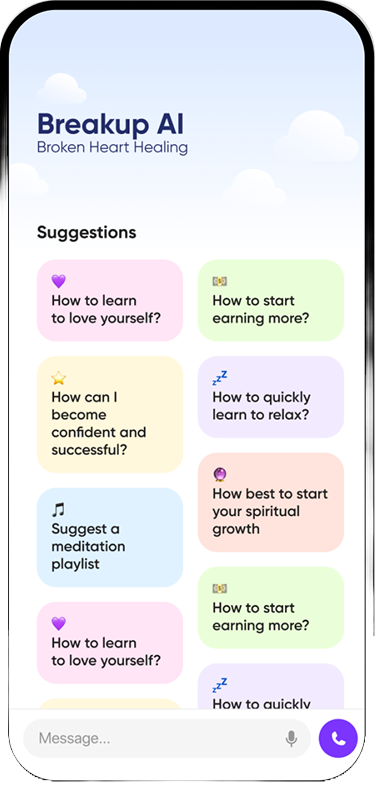
You’re not imagining it: healing shows up in steadier sleep, gentler self-talk, fewer compulsions, clearer boundaries, and a future that feels possible again. Small choices—movement, mindfulness, connection—teach your nervous system that it’s safe. You don’t have to do this alone. Try Breakup.one, an AI-powered heartbreak recovery companion with 24/7 support and guided healing programs: https://breakup.one/
References
- American Psychological Association (APA) – Grief
- National Institute of Mental Health (NIMH) – Stress
- Centers for Disease Control and Prevention (CDC) – How Much Sleep Do I Need?
- Harvard Health Publishing – Exercise and Depression
- World Health Organization (WHO) – Physical Activity Fact Sheet
- Mayo Clinic – Mindfulness Exercises
- Harvard Health Publishing – The Health Consequences of Loneliness
- Mayo Clinic – Complicated Grief