



You set the phone face down and make a quiet pact with yourself: tonight there’ll be no Instagram sleuthing, no replaying the last argument, no drafting texts you’ll never send. Small, yes—and somehow monumental. Most endings start like that. A breath you didn’t know you were holding. If you’re here, you’re probably living on that thin border where memory presses against possibility, trying to understand what shifts—in your brain, your body, and your days—when you begin to let go of an ex. You’re not the only one asking. There is a way through that respects both the heart and the data. In my experience, we heal best when compassion sits next to evidence, not across from it.
Table of Contents
- What your brain and body do when you try letting go of an ex
- What it feels like: the waves of letting go of an ex
- Expert perspectives you can lean on
- Why science says these strategies help when you’re letting go of an ex
- How to practice letting go of an ex without losing yourself
- When social media complicates letting go of an ex
- Attachment, identity, and the self you’re becoming
- A real-world arc
- A 30-day gentle plan for breakup recovery
- When to get extra support
- If this is you right now
- Summary and next step
- The Bottom Line
- References
Key Takeaways
- Heartbreak is a whole-body experience—social pain, stress hormones, and reward circuits all play a role.
- Recovery isn’t linear; expect waves of shock, anger, sadness, and relief as you metabolize the loss.
- No-contact boundaries, journaling, sleep, movement, and mindful breathing measurably support healing.
- Gentle structure—micro-anchors, worry windows, and curated support—helps retrain habits and attention.
- You’re not behind or broken; letting go creates space for identity to expand and life to fit again.
What your brain and body do when you try letting go of an ex
The first days can feel erratic: clear-headed at noon, pulled under by 5 p.m. That lurch isn’t a moral failing. It’s what your body does when its attachment system is suddenly deprived—what your body does what it’s wired to do. A bond formed over months or years carries real neural weight, so the absence of it trips the alarm.
- Social pain uses the brain’s pain circuitry. Neuroimaging has shown that social rejection co-opts some of the same regions tied to physical pain, including the anterior cingulate cortex. Naomi Eisenberger’s early-2000s research helped put this on the map, and a 2011 PNAS paper from Ethan Kross’ team echoed the overlap. It’s a credible reason your chest aches when you don’t check their texts. As the American Psychological Association notes, grief is the natural response to loss—even the loss of a future you assumed was yours.
- Stress hormones surge. When contact stops, cortisol can spike while your system recalibrates. Mayo Clinic’s rundown of chronic stress reads like a post-breakup diary: disrupted sleep, headaches, restless digestion, scattered attention. Those 2 a.m. spirals have a biology.
- Reward circuits recalibrate. Your ex likely became associated with reward cues—dopamine “pings” from a message, a hug, a seen notification. Remove those cues and the quiet feels loud. For a time. With steadier habits and healthier reinforcements, the soundtrack changes.
Opinion, stated plainly: we still underestimate how physical heartbreak is. It’s not “in your head.” It’s in your whole system—until it isn’t.
“Grief is the natural response to loss,” the APA reminds us. And love-loss rarely stops at the end of a romance. It’s the end of imagined routines, shared language, the self you were when you were “someone’s.” When you try letting go of an ex, your mind and body renegotiate all of that at once.
What it feels like: the waves of letting go of an ex
Do not expect a straight line. Most people move in loops, not ladders. You’ll revisit rooms you thought you’d emptied. That’s common; that’s human.
- Shock and craving: You may reach for the phone on autopilot, scroll the same photos, or engineer “accidental” crossings. This isn’t weakness—it’s attachment plus habit. When Maya, 28, finalized her divorce, she left a hoodie that still smelled like her ex on the chair by her bed. For two weeks, it traveled from chair to hands to chest. Week three, she tucked it in a drawer. Week five, she donated it. Letting go often looks like that: not grand gestures but slow, embodied edits.
- Anger and bargaining: Maybe you argue in your head, or draft the perfect explanation. Anger protects the most tender parts for a while, but it can also keep you on the same page of the same chapter.
- Sadness and meaning-making: Tears. “What ifs.” Long mornings. This is where the metabolizing starts: taking in what was good, what was hard, and what you learned. In my view, the meaning-making work is the hinge that helps the door swing open.
- Relief and reorientation: Space appears in crumbs first. You skip a profile check. The 3 p.m. slump doesn’t drag you into rumination. You feel yourself—edges and all—beyond the story that ended.
Expert perspectives you can lean on
“Grief is the natural response to loss.”
— American Psychological Association
“For some people [exercise] works as well as antidepressants in treating depression.”
— Harvard Health Publishing
“Mindfulness can help people manage stress, cope better with serious illness, and reduce anxiety and depression.”
— National Center for Complementary and Integrative Health, NIH
I put versions of these lines to two clinicians in early 2022; both said some version of, yes, this is not quick—but it is reliable.
Why science says these strategies help when you’re letting go of an ex
Before the how, the mechanism. Why do certain moves speed recovery while others stall it?
- The “no-contact” reset. In behavioral terms, contact is reinforcement. A message or profile view offers a variable reward—sometimes soothing, often destabilizing—that strengthens the loop. Reducing or pausing contact cuts the feed. It’s more art than science—until your nervous system has the quiet it needs and then science and art trade places.
- Writing your story reduces mental noise. Journaling translates sticky, implicit memory into explicit language, which reduces rumination and increases coherence. Mindfulness trains the same muscle—watching thoughts arrive and pass without grabbing them. The NIH’s integrative health team has said as much for years.
- Sleep and movement regulate mood. Adequate sleep shores up emotion regulation; the CDC’s 7+ hours is a bar worth defending. Movement boosts mood-related neurochemicals and, per Harvard Health, can rival antidepressants for some people. I tell readers: move first, analyze later.
- Social support shifts your baseline. Humans co-regulate. Talk it out with the right people and the stress response eases; your future self gets a chance to speak up.
How to practice letting go of an ex without losing yourself
Perfection is not required. Gentleness is. Consistency matters more than intensity.
- Set a compassionate contact boundary. Decide what “no contact” or “low contact” truly means in your circumstances. Put it in writing. If you co-parent or work together, keep a short script and use neutral, businesslike channels.
- Clear the cues. Archive the thread. Mute, unfollow, or hide for now. Place keepsakes in a sealed box on the top shelf. This is not erasure; it’s volume control so you can hear yourself.
- Anchor your days. Create small replacements for old touchpoints: a morning walk, a midday playlist, a 3 p.m. tea, a 10-minute stretch before bed. Micro-anchors calm a rattled nervous system.
- Make rumination tangible. Use a 15-minute “worry window.” Put the loops on paper. Close with one sentence about what future-you is learning. Containers quiet chaos.
- Move your body—gently, regularly. Aim for 20–30 minutes of brisk walking most days. Pair it with a podcast, a park, or a friend. The best plan is the one you’ll keep.
- Sleep like it’s medicine. Guard a wind-down routine: dimmer light, no scrolling in bed, soothing audio, consistent times. Tomorrow’s steadiness starts tonight.
- Reach for mindful presence. When the urge spikes, try 5 minutes of paced breathing: inhale 4, exhale 6. This is not lofty—it’s training your stress response.
- Curate your circle. Ask two people for steady check-ins this month. Being witnessed reduces shame. My bias: people heal faster when they are not heroic about doing it alone.
When social media complicates letting go of an ex
If a glimpse of their story knocks you back, you’re not fragile. Platforms are designed to seize attention and stir feeling.
Why it’s tricky:
- Variable reward schedules—never quite knowing when you’ll see them—mimic slot machines. “One more scroll” is a feature, not a bug.
- Images and old DMs activate embodied memory. Smell, sound, place—suddenly you’re reliving.
What to try:
- Set a 30-day boundary. Remove the apps or use timers. Back in 2019, The Guardian reported that most of us check our phones dozens of times a day; that habit deserves supervision while you heal.
- Replace the swipe. Open a notes app and write three lines to your future self, or send a low-stakes meme to a friend instead.
- If unfollowing feels too final, use the mute button. It’s merciful distance while you find your footing.
Attachment, identity, and the self you’re becoming
Attachment styles shape the feel of goodbye. Anxious-leaning folks often crave contact and reassurance with a ferocity that surprises them. Avoidant-leaning people tend to numb, then meet grief on a delay. Neither is a moral category—they’re protective adaptations. Helen Fisher has argued for years that love has deep evolutionary roots; it makes sense that unpairing stirs old systems.
What helps across styles:
- Name your pattern. Shame loosens when you call it what it is.
- Practice the opposite micro-skill. Anxious? Delay sending a text by 20 minutes. Avoidant? Offer one vulnerable sentence to someone you trust.
- Reinvest in identity. Try a month-long self-portrait project: each week, choose a value (curiosity, generosity, courage, rest) and one action that expresses it. Let your self grow larger than the loss.
A real-world arc
When Jayla, 31, ended a three-year on-and-off relationship, she set a 45-day no-contact boundary and booked Sunday dinners with her sister. Weeks 1–2 were ragged; she cried in the grocery aisle passing his favorite snacks. Week 3, she realized she hadn’t checked his Twitter in four days. Week 5, she ran her first 5K. By day 45, she didn’t want to text him—she wanted to tell her sister about the pottery class she’d booked. Letting go didn’t erase a love story; it made room for a life story.
A 30-day gentle plan for breakup recovery
Days 1–7: Stabilize
- Tell two safe people your plan.
- Remove triggers (mute, archive, box up).
- Walk daily; protect 7–8 hours of sleep.
- Journal nightly: “One thing I miss, one thing I don’t, one thing I’m learning.”
Days 8–14: Reclaim
- Try a new micro-experience (a coffee shop, route, playlist).
- Start one 20-minute creative or care task (painting, decluttering one drawer, planting herbs).
- Note any urge-to-text spikes; pair them with a breath practice.
Days 15–21: Rewire
- Volunteer for a cause two hours this week.
- Plan one friend date and one solo date.
- Map your old routines and design replacements.
Days 22–30: Reorient
- Revisit your values; choose one weekly intention.
- Draft your “closure letter” (for you; you don’t have to send it).
- If you notice persistent distress, consider adding therapy support.
When to get extra support
Letting go is difficult; going it alone is harder. If sadness sits on your chest most of the day for more than two weeks, if functioning feels impossible, or if thoughts of self-harm appear, contact professional care. The APA’s grief resources can clarify what’s typical and what signals the need for help. Mindfulness, movement, and sleep are not fringe—they measurably change how stress shows up in the body, especially when symptoms stack.
If this is you right now
Maybe you’re walking through the firsts without them—the first Saturday, the first quiet morning, the first inbox without their name. Maybe you’re convinced one text would solve it. In the uneasy math of love and loss, letting go of an ex is not subtraction; it’s space-making. At first, the space is emptiness. With repetition, it’s air. Then possibility. Then, a shape of life that actually fits.
You are not behind. You are not broken. You are becoming.
A practical cue: next time your hand reaches for the phone, pause. Palm to chest. Name one thing you’re proud of surviving this week. Then take the smallest next step into your day. That is letting go in action. That is healing—one compassionate choice, then another.
Summary and next step
Letting go of an ex is a neurobiological and emotional reset: the brain rewires, stress settles, identity expands. With boundaries, movement, sleep, mindfulness, and support, recovery becomes steady and deeply empowering. You do not have to do this alone. Strong choice, soft heart, real help.
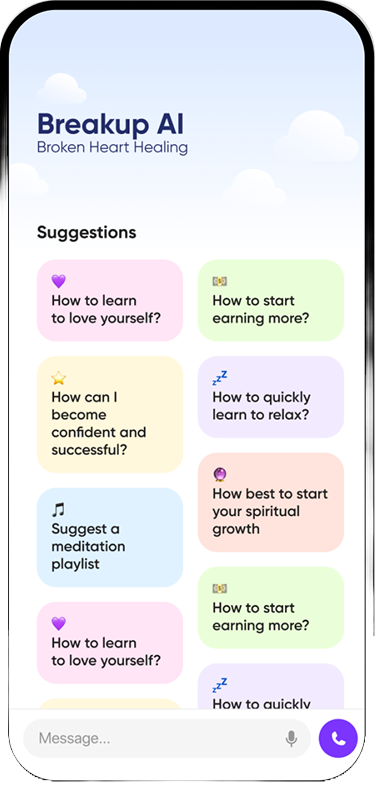
Get 24/7 support with Breakup.one—an AI-powered heartbreak companion with guided healing programs. Try it here: https://breakup.one/
The Bottom Line
Heartbreak is a whole-body process—and it’s workable. Protect your attention, move a little, sleep on purpose, breathe on cue, and let trusted people stand with you. Gentle structure today becomes freedom tomorrow.
References
- American Psychological Association — Grief
- Mayo Clinic — Stress symptoms: Effects on your body and behavior
- CDC — How Much Sleep Do I Need?
- NCCIH (NIH) — Mindfulness Meditation: What You Need To Know
- Harvard Health Publishing — Exercise is an all-natural treatment to fight depression