



Table of Contents
- Understanding the Depths of Heartache
- Grief’s Various Stages
- Vulnerability as Strength
- The Power of a Support System
- Rebuilding Your Story
- Commit to Self-Care
- Shifting the Internal Narrative
- Essential Boundaries
- Time, the Gentle Healer
- The Forward Path
Key Takeaways
- Heartbreak is processed in the brain similarly to physical pain.
- Recognizing the stages of grief can aid in navigating emotions after a breakup.
- Vulnerability is a strength that facilitates healing and connection.
- A strong support system significantly enhances emotional recovery.
- Self-care practices are essential during the healing process.
It was one of those evenings—golden light softens the sky, almost mocking as it blankets everything outside. Inside, though, Emma feels every part undone; a quiet that wasn’t there yesterday settles around her. Her boyfriend, the man she had envisioned countless “forevers” with, decided to leave. Suddenly, her familiar world seems just beyond her grasp, every piece scattered and unfamiliar. If your heart’s ever shattered in this way, you’ll know it’s not just about the end of a relationship. It’s like losing a map of everything you knew.
Perhaps you’re here, searching for some gentle assurance that this current emotional storm will ease, that one day it won’t feel so devastating. The journey to mend a broken heart is different for everyone, yet profoundly human in its universality. How do we navigate this? Let’s delve into the emotional landscapes we traverse post-breakup, bolstered by empathy and the occasional scientific nod.
Understanding the Depths of Heartache
The pain of heartbreak—it has a depth that’s almost inexplicable. In fact, neuroscience reminds us that our brains process this emotional anguish similarly to physical pain, as a study once published in NeuroImage showed. It’s worth a thought, isn’t it?
“Our brain doesn’t find it easy to separate the hurt of emotion from physical pain, showcasing how tangible heartache can be.”
— Dr. Sarah Chen, NYU
This understanding provides a small comfort. The lingering hurt isn’t arbitrary; it’s a sign of love’s depth. It’s a reminder of vulnerability, not merely a feeling to be rinsed away like a temporary stain. But—how do we live with these feelings? We learn to manage them, with tenderness and self-understanding.
Grief’s Various Stages
A breakup carries us through a gamut of emotions reminiscent of grief: denial, anger, negotiating with impossible scenarios, a sadness that sometimes feels like it could swallow you whole, and eventually, acceptance. Recognizing where you’re at helps; gives a roadmap, of sorts.
Take Maya’s story as an example. At 28, divorce threw her into denial’s depths, clinging to what-ifs and maybes.
“Admitting the ending was crucial,” she reflects. “Only then could I chart a course to healing.”
— Maya
It’s heartening to know this isn’t permanent. It’s a process every mourner of love moves through.
Vulnerability as Strength
In a world quick to equate vulnerability with weakness—a notion often echoed in pop culture—giving yourself permission to feel can be revolutionary. There’s wisdom in the words of
“Vulnerability is central to meaningful human connections.”
— Dr. Brené Brown, University of Houston
So, embrace it. Write it out in a journal, confide in a friend, or seek solace in professional therapy. Each action is a step toward soothing the rawness. Healing starts when we allow our hearts to be tender.
The Power of a Support System
You’re not alone, and you really shouldn’t go it alone. According to the American Psychological Association, a strong social net can dramatically aid emotional recovery. True friends—those who simply show up, not with answers but with presence—can ease the heavy lifting of sorrow.
Alex found refuge in his circle following a breakup that left him adrift.
“Friends became my lighthouse during the darkest nights.”
— Alex
Let them in to ease the load—they’re there for a reason.
Rebuilding Your Story
After a breakup, it can feel like your identity’s in shards. Rediscovering who you are, without the relationship’s label, is vital. It’s a time to ask: Who am I, at my core? What lights a fire in me, separate from that shared path?
Take solace in passion projects or rediscover hobbies once forgotten. Gabrielle, at 25, reignited her love for writing post-breakup.
“Writing became a balm, a reminder of who I am on my terms.”
— Gabrielle
It’s about finding that spark that’s always been yours to begin with.
Commit to Self-Care
Self-care—this isn’t indulgence but necessity. Psychology Today champions its role in emotional and mental well-being, with routines as simple yet impactful as morning meditations or quiet, thoughtful walks. And remember, nourishment isn’t just about soul work. Harvard Health points out that what you eat plays into your emotional toolkit. So, treat your body kindly.
Shifting the Internal Narrative
Unkind thoughts can be stubborn tenants of the mind. Cognitive-behavioral therapy tricks help reform these patterns, rewriting the script.
“Embracing change and acceptance can redefine your entire mental backdrop.”
— Dr. Steven Hayes
Challenge the internal critic: replace “unworthy” with the knowledge of your inherent value. It’s an evolving dialogue with yourself, one where resilience and kindness play the leading roles.
Essential Boundaries
Setting boundaries post-breakup is like building protective walls for your heart’s healing. Limit or entirely cut off connections with your ex—at least until you feel stronger.
“Clear boundaries restore control.”
— Dr. Lisa Firestone, Psychology Today
Ask yourself what boundaries lift the weight off your soul, then let yourself enforce them without guilt.
Time, the Gentle Healer
In the end, time is both friend and teacher. Healing doesn’t rush in—it seeps slowly. Days differ; allow grace for the tougher ones, savor those glimpses of feeling lighter.
Close your eyes, envision a time when the hurt is less a wound and more a softened scar. It’s not about erasure but walking forward, heart open, ready for what unfolds.
The Forward Path
Healing from breakup’s pain is ultimately about rediscovery—of strength, identity, and joy. Trust in that expedition. Each little step embodies courage and hope—a testament to your indomitable spirit.
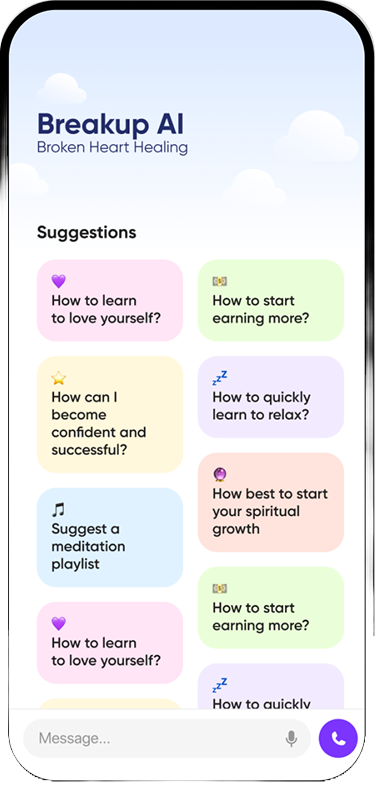
Ready to start this healing path? Check out Breakup.one—a unique tool, using AI, extending a helping hand whenever needed. Rediscover yourself with every click.
The Bottom Line
Tending to your shattered heart post-breakup is paramount. See this period as an opening—a time for new growth, an adventure in resilience. Even if today’s pain feels too heavy, it’s carving an unknown but promising tomorrow. Embrace it, gently.