



Table of Contents
- Understanding Heartbreak and Self-Worth
- The Science Behind Self-Worth and Breakups
- Embrace the Grieving Process
- Reconnect with Yourself
- Practicing Self-Compassion
- Build a Support System
- Set New Goals
- Nurture Your Body and Mind
- Seek Professional Help If Needed
- Moving Forward with Empowerment
- The Bottom Line
- References
Understanding Heartbreak and Self-Worth
At the outset, it’s crucial to acknowledge the emotional tumult a breakup inevitably brings. What’s lost isn’t merely a partner—it shakes the very foundation of who you are.
“We associate our worth with our partner’s viewpoints.”
— Lucy Atkinson, Therapist
When Maya, 28, went through her divorce, it was as if her self-esteem nosedived overnight.
“I couldn’t even look at myself in the mirror,”
— Maya, 28
she says. But rather than getting swallowed by despair, Maya saw this as a painful yet pivotal chance to uncover her true self, outside the shadows of her relationship.
The Science Behind Self-Worth and Breakups
Our sense of self-worth doesn’t just affect our mood—it tangibly impacts mental health.
“Your self-concept’s not static. Post-breakup, reestablishing it independently is vital.”
— Dr. Sarah Chen, Clinical Psychologist
It’s an idea both daunting and liberating.
Embrace the Grieving Process
The first step toward healing is acknowledging your grief. Allow yourself to feel the full range of emotions—anger, sadness, confusion. They are all natural parts of the grieving process. Suppressing these emotions can actually lead to prolonged depression and anxiety. Research from the Mayo Clinic underscores that facing grief openly can lead to healthier emotional processing. Cry if you need, or write. Talk. Your feelings are legitimate and deserve expression.
Reconnect with Yourself
It’s time to embark on self-discovery. What thrilled you before the relationship took over? Getting back into old hobbies can be both empowering and enlightening. Over time, these activities help to reignite personal passions and remind you of who you are—and have always been deep down. Consider forming a closer bond with yourself through journaling. An article from Harvard Health highlights how journaling nurtures self-awareness and stress management. It could be your compass in this stormy journey, helping track growth and shifts in perspective.
Practicing Self-Compassion
In reestablishing self-worth, practicing self-compassion is crucial.
“Speak to yourself as you would to a dear friend.”
— Dr. Kristin Neff, Self-Compassion Researcher
Begin by silencing that harsh internal critic. Replace negativity with affirmations, maybe a simple “I am worthy of love and happiness” or “My value isn’t defined by anyone else.”
Build a Support System
You’re not meant to face this darkness alone. Reach out to those who uplift you—friends, family, even coworkers. They can shine a light on your forgotten strengths just when you need it. The National Institutes of Health found that robust social networks enhance psychological well-being and mitigate depressive symptoms. So even when solitude beckons, try reaching out, if only for a quick chat over coffee or a stroll.
Set New Goals
Setting new personal goals can be a meaningful way to affirm your identity and self-worth. They don’t have to be monumental; even small, achievable goals that align with your values can reinvigorate self-esteem and restore a sense of purpose. Maya, for instance, committed to running a charity 5K. Not only did this offer her physical accomplishment, but it also connected her to a cause she deeply cared about, reinforcing her worth beyond a past relationship.
Nurture Your Body and Mind
Connecting physical and mental health is paramount. Exercise releases endorphins, those wonderful mood elevators. A study by the CDC indicates regular physical activity sharpens minds and reduces stress. Complementing this with mindfulness or meditating—apps like Headspace offer guidance—can bolster awareness and acceptance of the present.
Seek Professional Help If Needed
Sometimes, despite your best efforts, healing might require professional assistance. Therapy can provide a structured space to unravel emotions and develop coping mechanisms. Cognitive-behavioral therapy (CBT) is known for its effectiveness in refining self-perception and breaking cycles of negative thought patterns.
Moving Forward with Empowerment
The path to rediscovering self-worth after a breakup is rarely straightforward. Expect setbacks and triumphs along the way. But remember, you’re on a unique journey—celebrate every small milestone passed, recognizing each as a testament to your resilience. As you continue this path, feel comforted knowing that you have the power to redefine happiness, realizing that your self-worth is intrinsic, untied from any past shadows.
A breakup might seem like a chapter’s close, yet it’s also the opening for a new one, rich with self-awareness and growth. You are not just healing; you are transforming yourself into a version perhaps brighter than before.
Key Takeaways
- Acknowledge your grief and allow yourself to feel the emotions that come with a breakup.
- Reconnect with your identity through hobbies and journaling.
- Practice self-compassion and counter negative thoughts with positive affirmations.
- Build a supportive network of friends and loved ones to aid in your healing journey.
- Consider setting new personal goals to boost your self-esteem and sense of purpose.
The Bottom Line
Rebuilding self-worth after a breakup is a journey of self-discovery and healing. It’s important to give yourself grace and take necessary steps to reconnect with who you are independent of past relationships. Each small action you take contributes to your growth and empowerment.
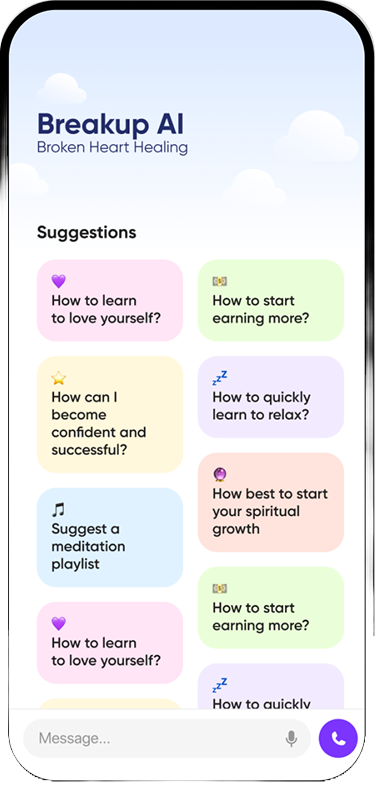
Feeling overwhelmed? Breakup.one is your all-night companion ready to help. It’s an AI-powered heartbreak recovery ally providing constant emotional support and guided healing pathways. Start your journey to feeling better today at breakup.one.
References
- Lee, Hexel, and Jenkins, “The Phenomenology of Breakup: Frequency and Emotional Impact,” Stanford University – https://psych.stanford.edu
- American Psychological Association. “Building Self-Esteem – Stress and Mental Health.” https://www.apa.org/news/press/releases/stress/2014/stress-report
- Mayo Clinic. “Grief Counseling: Benefits and Therapy.” https://www.mayoclinic.org/tests-procedures/grief-counseling/about/pac-20385260
- Harvard Health Publishing. “The Health Benefits of Journaling.” https://www.health.harvard.edu/healthbeat/writing-about-emotional-experiences-as-a-pathway-to-better-health
- National Institutes of Health. “The Impacts of Social Networks on Emotional Well-being.” https://www.ncbi.nlm.nih.gov/pmc/articles/PMC3150158/
- Centers for Disease Control and Prevention. “Physical Activity and Health.” https://www.cdc.gov/physicalactivity/basics/pa-health/index.htm
- American Psychological Association. “Cognitive Behavioral Therapy for Depression.” https://www.apa.org/ptsd-guideline/patients-and-families/cognitive-behavioral