



Table of Contents
- The Anatomy of Breakup Depression: Foundational Steps in Recovery
- When Heartbreak Resembles Life’s Final Curtain
- Practical Pathways Forward
- Enhancing Mental Health Post-Breakup
- Embrace Exploration: Craft Your New Identity
- Pursue Personal Evolution and Acceptance
- Facing Tomorrow: Moving Forward with Determined Intent
Key Takeaways
- Breakup depression mirrors the experience of grief and involves complex emotional states.
- Self-compassion and acceptance are crucial in navigating the healing journey.
- Reconnecting with social circles and engaging in self-care enhances recovery.
- Exploring personal interests offers opportunities for identity renewal post-breakup.
The Anatomy of Breakup Depression: Foundational Steps in Recovery
Let’s start here: before embarking on a journey to overcome breakup depression, it’s crucial to understand what’s occurring in both mind and body. Emotionally, the end of a romantic relationship mirrors grief. Why? Because losing someone we love, even in amicable separations, profoundly shakes the foundations of our lives. A paper published by the Journal of Neurophysiology reveals how the anguish of surrendering love triggers the same brain regions activated by physical pain. Isn’t it fascinating how tightly woven our brains and hearts are?
“The depression following a breakup often involves a sense of hopelessness, paralysis in motivation, and profound sorrow, echoing major depressive episodes. However, this kind of depression is situational, implying that with proper interventions, it can be gradually relieved.”
— Dr. Sarah Chen, Clinical Psychologist, NYU
When Heartbreak Resembles Life’s Final Curtain
Consider Maya, age 28, for whom the end of a six-year relationship felt like a piece of her identity had been stripped away. “Being ‘Maya and Tom’ for so long, I now struggle to comprehend just being ‘Maya,'” she confesses. This desolation and loss are familiar because relationships sculpt our daily lives and self-perception. From a psychological perspective, our brain’s reward system craves the emotional highs from past connections—those dopamine surges from affectionate exchanges.
“Before, during, and after relationships, your levels of oxytocin—the ‘love hormone’—are heightened. A breakup ceases its normal flow, causing ‘love hunger’ that underpins that heavy longing in your chest.”
— Catherine Wood, Emotional Healing Therapist
Practical Pathways Forward
Remember, there’s no single road to recovery—it’s an intricate dance with both forward and backward motions.
Grant Yourself the Grace to Grieve
First off, give yourself permission to truly feel. This isn’t indulgence—it’s necessity. Dr. Elisabeth Kübler-Ross’s model, illustrating denial, anger, bargaining, depression, and acceptance, effectively applies to breakups. Resist the urge to skip these stages or the cycle merely prolongs.
Reignite Your Social Connections
Isolation can magnify despair. Reconnecting with old friends (or diving deeper into new ones) can replenish your psychological reserves. According to folks at Brigham Young University, robust social networks can heighten survival rates by over 50%.
Cultivate Self-Care and Routine
Healthy habits nurture both mind and body. Researchers at University College London suggest that new habits set in after roughly 66 days. Incorporate routines fostering well-being, like consistent sleep, nutritious meals, and physical activity.
Banish the Ghosts of Relationships Past
Hoarding tokens of the past keeps wounds open. Cognitive-behavioral insights propose altering environments aids in reshaping emotional responses.
Seek Professional Guidance
Therapy provides an organized way to process emotions. Cognitive-behavioral therapy excels at countering negative thought spirals.
Enhancing Mental Health Post-Breakup
Healing isn’t solely about mending—it’s about fortifying for future trials. Incorporate mindfulness and gratitude practices. Dr. Jon Kabat-Zinn, mindfulness pioneer, champions awareness to increase emotional resilience.
Embrace Exploration: Craft Your New Identity
Breaking up provides an unusual opportunity—for discovery. When 25-year-old Lisa ended a relationship, she ventured solo, visiting museums, tuning into live music, and reigniting her passion for painting. These experiences sculpted her individual identity post-relationship.
Invest in hobbies, engage in clubs, or partake in workshops that draw you in. Innovation and exploration can illuminate self-renewal pathways. The American Psychological Association suggests engaging meaningfully can counteract depressive states, enhancing life satisfaction.
Pursue Personal Evolution and Acceptance
Reflect on the relationship’s teachings about love and yourself. In every heartbreak, there is indispensable wisdom, paving the way for brighter futures. Acknowledge the bravery necessary to both confront and embrace change.
Facing Tomorrow: Moving Forward with Determined Intent
Braving breakup depression is akin to climbing a daunting hill with a burdensome pack. Each step feels immense, yet with time, burdens lighten. You’ll reach a summit from which reflection illuminates your journey’s worth.
“Meeting change with self-compassion and openness, you grow stronger. Breakups, initially perceived as endings, are often profound beginnings—stepping stones to self-discovery and expansion.”
— Dr. Lucas Nguyen, Relationship Psychologist
Remember, if solitude weighs heavy, reach out for support. Explore resources, like therapy and self-help circles, guiding emotional healing.
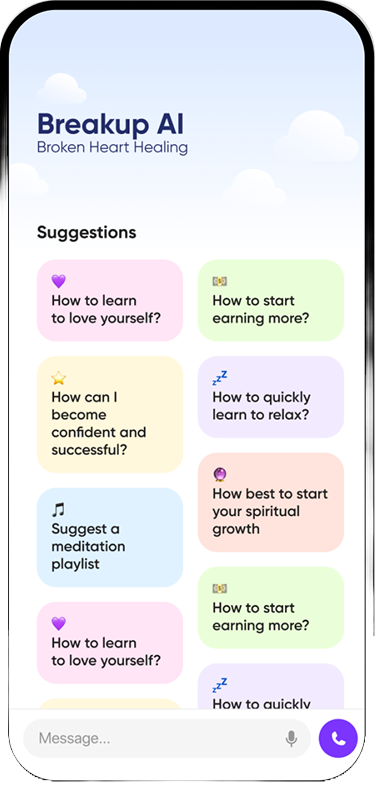
For structured aid, consider programs like Breakup.one, offering AI-driven support around the clock. It’s like a compassionate companion, with you every step towards renewal and rebirth.
The Bottom Line
Recovering from breakup depression demands time and kindness toward oneself. As hope is reconstructed, and identity reshaped, personal growth deeply anchors the journey. You’re not merely healing; you’re transforming—and that transformation is incredibly profound.